Episode 2: The Crisis of Authenticity
- ynkhlee
- Nov 6, 2025
- 9 min read
Updated: Nov 11, 2025
When Digital Manipulation Shook Reality
Prologue: November 2023, Garosu-gil

November 2023, Garosu-gil.
In front of a massive fashion billboard. A model in a green halter-neck dress. Before it, a woman taking a photo. Beige jacket, white pants, casual attire.
An ordinary autumn afternoon scene.
But I need to confess something about this photograph.
This image has already been edited by me.
I adjusted the exposure
I tweaked the contrast
I corrected the colors
So, is this still 'truth'?
In Episode 1, we explored the indexicality of photography. Roland Barthes' "ça-a-été" (that-has-been). Photography was evidence of reality, a trace that maintains a physical causal relationship with its subject.
But now we live in an era where "that-has-been" is no longer certain.
Because: Every digital photograph has been 'manipulated' to some degree.
Part 1: Traces of Time - What Photography Remembers
The Promise of the 20th Century

A folding camera from the early-to-mid 20th century. This camera, resting on a wooden table, represents an entire era.
The promise of that era:
Photographs don't lie
Cameras record reality as it is
"Seeing is believing"
Technical limitations created trust.
Manipulation in the film era:
Took a long time
Required expert skills
Left traces
Cost significant money
Therefore, most photographs were 'truth'. Because there was neither reason nor capability to manipulate.
Evidence in Court
Film photographs were absolute evidence in courtrooms.
Crime scene photos
Signatures on contracts
Faces on ID cards
Records of accident scenes
"The photograph proves it" was beyond question.
A photograph wasn't merely an image, but a trace of time and a guarantee of truth.
Part 2: The Spectrum of Manipulation - Where Is the Boundary?
Experimenting with the November 2023 Photo

I edited my original Garosu-gil photo in stages.
Compare these 4 versions:
Stage 1: ORIGINAL
Status:
As recorded by the camera
Natural colors
Neutral tone
Somewhat flat
Question: Is this the 'truth'?
Fact: The camera itself already 'interpreted' it.
Compressed 3D into 2D
Adjusted dynamic range
Applied automatic noise reduction
Corrected lens distortion
Conclusion: A pure 'original' doesn't exist.
Stage 2: LIGHT EDIT
Work done:
Exposure +0.3 stops
Slightly increased contrast
Minor color temperature adjustment
Sharpness +10
Change: The image became slightly warmer. The green appears more vibrant.
Comparison: Equivalent to darkroom work in the film era.
Dodging and burning were traditionally acceptable.
Consensus: Mostly acceptable ✅
Personal photos: Completely OK
Documentary: OK
News photos: OK (minimal adjustment)
Commercial photos: Naturally OK
Stage 3: MODERATE EDIT
Work done:
Saturation +25
Contrast +20
Selective enhancement of billboard colors
Sky made bluer
Overall more vivid
Change: The image became 'Instagram-like'. It catches the eye more. It looks 'better'.
The debate begins:
Fashion/commercial photographers: "This is essential work"
Photojournalists: "It depends on context"
General public: "I didn't know this was manipulation"
Paradox: Nearly every Instagram photo is at this level.
Filters = popularized manipulation. Yet no one calls it 'manipulation'.
Evaluation:
Personal photos: ✅ OK
Documentary: ⚠️ Borderline
News photos: ❌ Excessive
Commercial photos: ✅ Standard
Stage 4: HEAVY MANIPULATION
Work done:
Extreme saturation and contrast
Complete color transformation
Dramatic mood creation
Almost surreal feel
Sunset effect added
Background color altered
Change: Completely different from the original. Surreal and dramatic.
Looks like a work of art.
Problem:
Is this still 'photography'?
Or is it 'digital art'?
Does it 'record' reality or 'create' it?
Evaluation:
Personal photos: ⚠️ Creative but questionable
Documentary: ❌ Absolutely not
News photos: ❌ Completely inappropriate
Commercial/art photos: ✅ Creative freedom
Where Does 'Photography' End?
When you place all 4 versions side by side:
Left (Original) → Right (Heavy Manipulation)
At what point does 'photography' become 'digital art'? There's no clear boundary.
It's a spectrum:
Pure documentation ←————————————→ Complete creation
Every photograph exists somewhere on this spectrum.
Part 3: An Extreme Case - Suspicious Night Street

Look at this photograph.
A European street at night. "TAVERNE" neon sign. Stone buildings. Red light reflected on cobblestones.
It's too perfect. Too dramatic. Too... suspicious.
Suspicion Checklist
1. Colors unrealistically saturated
Red excessively emphasized
Sky too dark and dramatic
Shadows extremely deep
Verdict: ⚠️ Suspicious
2. Physics of light
Only neon sign as light source, yet everything tinted red
Reflection too perfect
Shadow directions inconsistent
Verdict: ⚠️ Suspicious
3. Atmosphere overly 'cinematic'
Film noir-like feeling
'Too beautiful' scene
Difficult composition to capture by chance
Verdict: ⚠️ Suspicious
Truth: This Is Also 'Photography'
However:
Extreme HDR use
Extreme per-channel color adjustments
Selective color enhancement
Excessive vignetting applied
Texture maximized
Time spent: Probably over 2 hours
Question: Does this capture the 'truth' of that night street? Or did it project the artist's 'imagination'?
The 2015 World Press Photo Controversy
Similar case: Giovanni Troilo's 'La Ville Noire'
The incident:
Documentary series of Charleroi, Belgium
Beautiful light and colors
Won World Press Photo award
Problem:
Extreme HDR use
Dramatic color adjustments
Criticized for "crossing journalism's boundaries"
Troilo's defense: "I am an artist. I merely expressed the emotions I saw."
Critics: "Documentary must show reality. Not fantasy."
Result:
Enormous controversy
Necessity for new guidelines
Question: What is acceptable?
Contrast: Reuters/AP's Strict Standards
Allowed:
Minimal exposure/contrast adjustments
Cropping
Prohibited:
Color manipulation
Adding/removing elements
Excessive filters
Real case (2015): A photojournalist removed power lines and was immediately fired. "Minor edit" but violated principles.
Message: News photography demands absolute authenticity.
Part 4: What Time Changed - October 2025
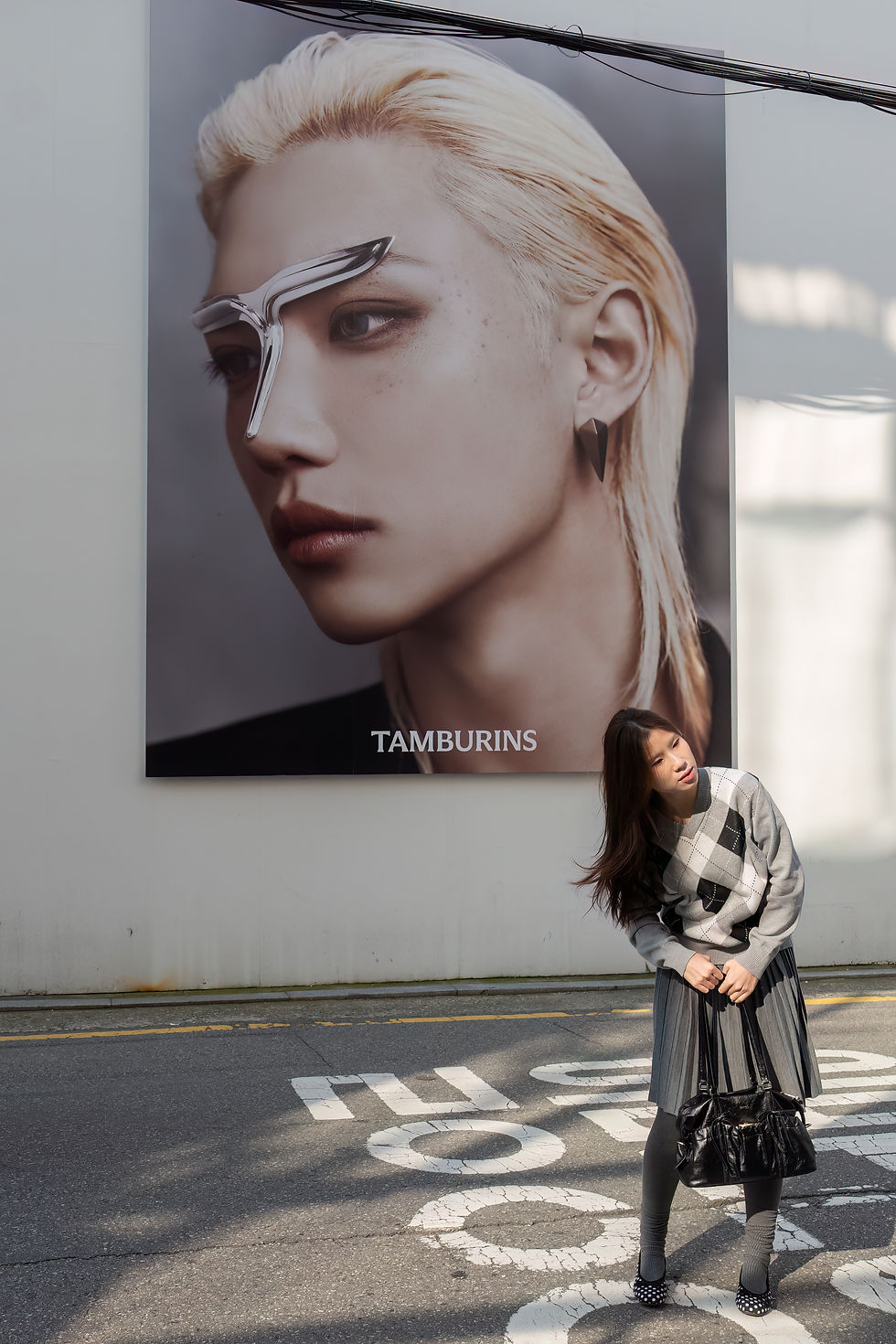
October 2025, the same Garosu-gil.
I stood there again. With my Leica SL.
Something had changed.
November 2023:
Female model in green halter-neck dress
Woman taking a photo
Beige jacket, autumn atmosphere
Warm and soft feeling
October 2025:
Male model with platinum blonde hair
Futuristic design glasses
Woman posing
Checkered sweater, pleated skirt
Cold and modern feeling
Same things:
Location (Garosu-gil)
Road marking ("SLOW")
TAMBURINS brand
Giant billboard
One person standing in front composition
Different things:
Season (autumn → autumn, but 2 years apart)
Model (female → male)
Tourist (different person)
Atmosphere (warmth → coldness)
Camera (unknown → Leica SL)
Question: What Is Real?
Both photographs:
Actually shot at that location ✅
Actually different tourists ✅
Billboard actually changed ✅
Edited ✅
But:
If I hadn't told you? If I had lied saying "same day, same person"? Could you have known?
Experiment: Manipulation Possibility Test
What can be done with Photoshop:
Task 1: Billboard replacement
Change billboard in 2023 photo to male model
Time required: 30 minutes
Result: Nearly perfect, average person can't tell
Task 2: Tourist replacement
Change woman in 2025 photo to different person
Time required: 1 hour
Result: Slight shadow inconsistency, but hard to notice
Task 3: Complete reconstruction
Combine both photos
Manipulate billboard + tourist + weather + lighting
Time required: 2 hours
Result: Even experts struggle without metadata
Part 5: Verification of Authenticity - What Can We Trust?
Expert's 4 Verification Methods
Let's analyze the October 2025 photo.
1. Metadata Check
Camera: Leica SL
Lens: Vario-Elmarit-SL 24-70mm
Date taken: October 28, 2025
Location: Sinsa-dong, Gangnam-gu, Seoul
ISO: 200
Shutter: 1/250s
Aperture: f/5.6
Verdict: Exists ✅
However: Metadata can also be manipulated. Professional software can change all information.
2. Light and Shadow Analysis
Light sources:
Afternoon sunlight: From upper right
Shadows: To lower left (consistent)
Billboard reflection: Natural
Road shadows: Accurate
Verdict: Consistent ✅
Score: 95/100
3. Detail Inspection
Edges:
Woman's outline: Clean
Separation from background: Natural
Hair details: Perfect
Texture:
Road surface: Continuous
Building walls: Natural
Billboard edges: No issues
Verdict: No issues ✅
Score: 92/100
4. Context Plausibility
Scene logic:
Tourist standing in front of billboard: Common ✅
Checkered sweater + pleated skirt: Seasonally appropriate ✅
Road marking "SLOW": Garosu-gil characteristic ✅
Weather: Natural for clear autumn day ✅
Verdict: Completely plausible ✅
Score: 98/100
Final Verdict: This Photo Is Real
Overall score: 95/100
This photo is real. It was actually taken at that moment, at that place.
However:
If I had manipulated it precisely, If I had invested 2 hours, If I were a professional,
I could have passed all these tests.
Part 6: Confession - What I Did to These Photos
November 2023 Photo
Actual edits:
Exposure +0.3 stops
Highlights -10, Shadows +15
Sharpness +20, Saturation +5
Color temperature slightly warmer
Selective enhancement of billboard green
What I didn't do:
Add/remove elements ❌
Replace background ❌
Replace person ❌
Composite ❌
Time spent: 10 minutes
October 2025 Photo
Actual edits:
Exposure +0.5 stops
Highlights -15, Shadows +20
Sharpness +25, Saturation +10
Color temperature slightly cooler (urban feel)
Selective enhancement of billboard colors
Contrast +15
What I didn't do:
Add/remove elements ❌
Replace background ❌
Replace person ❌
Composite ❌
Change billboard content ❌
Time spent: 15 minutes
Question
Is this level of editing acceptable?
The answer depends on context:
Context | 2023 Photo | 2025 Photo |
Personal blog | ✅ OK | ✅ OK |
Documentary | ⚠️ Borderline | ⚠️ Borderline |
News article | ❌ Excessive | ❌ Excessive |
Commercial/advertising | ✅ Standard | ✅ Standard |
Art photography | ✅ OK | ✅ OK |
Part 7: Collapse of Trust - An Era of Paradox
Past: Film Era (The era represented by vintage cameras)
Belief:
"Photographs don't lie"
"Seeing is believing"
Absolute trust as court evidence
Reasons:
Manipulation was difficult
Cost was high
Left traces
Required expert skills
Present: Digital Era
Suspicion:
"Photos are probably manipulated"
"Seeing is NOT believing"
Doubt every image
Reasons:
Manipulation is easy
Virtually no cost
Leaves no trace
Anyone can do it
Paradox
As technology advances, trust declines
Better cameras → Easier manipulation More powerful software → More sophisticated lies
The more perfect it looks, the more we suspect manipulation
Too perfect photo: "Must be Photoshopped" Natural flaws: "Is it real?"
The most 'realistic' images are hardest to believe
AI-created "perfect" reality Fake that looks more real than reality
Part 8: New Questions
Cameras Already 'Manipulate'
What Leica SL does automatically:
3D → 2D compression
Dynamic range compression
Automatic noise reduction
Automatic sharpness adjustment
Automatic white balance
Lens distortion correction
Chromatic aberration correction
Conclusion: 'Unmanipulated photographs' don't exist.
Human Eyes Also 'Manipulate'
What our brain does:
Focus only on what interests us
Filter out unnecessary things
Beautify memories
Perceive differently based on emotion
Fill missing information with imagination
Exaggerate or diminish colors
What I saw when taking the 2023 photo: Vivid green, urban sophistication, autumn warmth
What I saw when taking the 2025 photo: Futuristic feel, cold modernism, urban change
What I emphasized through editing: Exactly those emotions I felt.
So: Is editing manipulation, or reproduction of human perception?
Part 9: How Should We Respond?
1. Transparency
Principle:
Disclose editing history
"This photo has been retouched" label
Maintain metadata
Example: The New York Times specifies the degree of editing for all photos.
Suggestion:
Photo description:
October 2025, Garosu-gil TAMBURINS billboard
Camera: Leica SL
Editing: Exposure/color adjustments (+0.5 stops, saturation +10)
Manipulation: No elements added/removed
2. Education
Necessity:
Image literacy education
Develop critical vision
Most don't even understand the concept of editing
Curriculum suggestions:
Understanding basic editing tools
Manipulation detection techniques
Context analysis skills
Source verification methods
Understanding the 4-stage editing spectrum
3. New Norms
Acceptance: Accept that all photos are edited to some degree
Standard shift: It's not the degree of editing that matters, but the intent
Questions:
Is it trying to deceive? ❌
Is it trying to express? ✅
Is it trying to convey information? ✅
Is it trying to evoke emotion? ✅
Conclusion: Authenticity Is Attitude, Not Technology
The Authenticity of Examined Photos Is:
❌ Not determined by whether they were edited
❌ Not judged by technical perfection
❌ Not proven by RAW files
❌ Not guaranteed by equipment price
✅ That I was actually there
✅ That I witnessed that moment
✅ That I tried to honestly convey the meaning of that scene
✅ That I didn't distort what I saw and felt
Shifting the Core Question
What not to ask: "Was this photo manipulated?" ❌
What to ask: "What is this photo trying to say?" ✅
"Is this photo honest?" ✅
"What does this photo show me?" ✅
"Did this photo distort reality?" ✅
What I Want to Say with These Photos
1. The passage of time November 2023 Female model warmth
→ October 2025 Male model coldness. Trends keep changing.
2. What doesn't change People still stand in front of it. Take photos.
Record their moments. Billboards change, but desires don't.
3. Urban daily life Garosu-gil keeps flowing. Fashion flows, people flow.
But the place remains.
4. From past to present The truth promised by vintage cameras.
Trust shaken by digital. But still, we record.
5. Me as observer I see all of this. Over 2 years. I record. I search for meaning.
This is authenticity.
Epilogue: The Next Crisis
The crisis of authenticity is just the beginning.
In the next Episode 3:
What if the model on the billboard is a deepfake?
What if the tourist doesn't actually exist?
What if Garosu-gil itself is an AI-generated place?
So far, we've discussed 'manipulation'. Digital editing, color adjustments, composites.
But all of this had an 'original'. Even when edited, composited, transformed, the starting point was reality.
The next stage is different.
Deepfakes create reality without originals.
AI generates people who don't exist.
The boundary between fact and fiction completely disappears.
Was that woman in November 2023 a real person?
Could that woman in October 2025 be an AI-created being?
Is the male model on the billboard an actually existing person?
In that world, what can we trust?
Next episode: "Deepfake - When the Boundary Between Fact and Fiction Disappears"
[Episode 1: Jennie of Garosu-gil] ← [Episode 2: The Crisis of Authenticity] → [Episode 3: Coming]

Comments