Episode 3: Deepfake - Stealing Faces
Updated: Nov 19, 2025
Prologue: March 16, 2022, Kyiv
Ukrainian President Zelensky. Or rather, someone wearing his face. [Source: BBC]
Three weeks into the Russian invasion. A Ukrainian news site was hacked.

The Zelensky in the video says: "Lay down your weapons. Surrender."
But this was not Zelensky.
Awkward voice intonation
Lip movements subtly misaligned
Suspiciously low image quality
Meta and Twitter removed it within hours. The Ukrainian government immediately denied it.
The first deepfake used as a weapon in information warfare during war.
What we learned from Episode 1: Photography proves "that-has-been." But now even faces are no longer evidence.
Part 1: What Is Deepfake? - When Faces Become Data
Deepfake = Deep Learning + Fake
Generative AI: Creates entirely new images Deepfake: Replaces only faces in existing videos
Not creation, but replacement. Not fabrication, but theft.
How It Works: GAN (Generative Adversarial Network)
One network → Generates fake faces Another network → Distinguishes real/fake
They compete and learn. Becoming increasingly sophisticated.
The mechanism:
Generator creates fake face
Discriminator judges: Real or Fake?
Generator improves based on feedback
Process repeats thousands of times
Result: Indistinguishable from reality
2017 Reddit debut → 2024 Everyday occurrence

Visual diagram showing the Generator-Discriminator competition loop, with INPUT (thousands of photos) → PROCESS (neural network training) → OUTPUT (synthetic face)
History of Evolution: From Crude to Undetectable
2017 Reddit Era:
Crude quality
Misaligned eyebrows
Obvious artifacts
Easily detected
2019 Smartphone Era:
FaceApp, Reface popularized
Consumer-friendly apps
Filter-like usage
Mass adoption begins
2021 Tom Cruise Moment:
TikTok deepfakes gain 11 million views
Even experts fooled
Professional-grade quality
Viral phenomenon
2022 Zelensky Case:
Weaponization in information warfare
Political impact
Global concern
Crisis point reached
2024 Present:
Real-time deepfakes possible
Instant generation
Indistinguishable from reality
The technology has matured
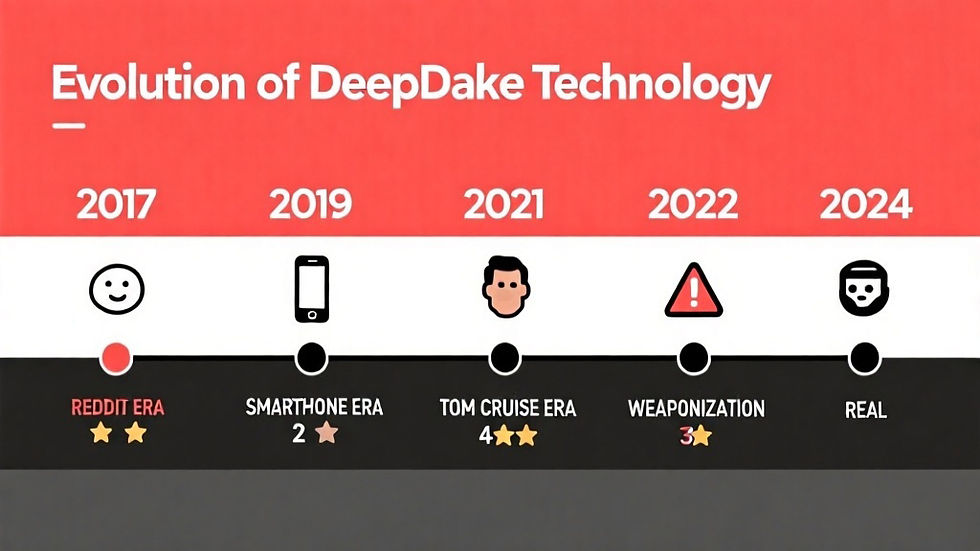
Timeline visualization showing quality progression from 2017 (★☆☆☆☆) to 2024 (★★★★★), with key milestones and characteristics at each stage
Question:
Is this merely manipulation? Or a philosophical question that asks us to reconsider the essence of photography?
Part 2: The Collapse of Indexicality - When Light No Longer Proves Reality
2024, Garosu-gil, Seoul: Same Space, Different Face
TAMBURINS store exterior wall. Large billboard.
2023: BLACKPINK Jennie 2024: Blonde Caucasian male model
This is not a deepfake. This is a real photograph of a real model.
But note the method of replacement:
Same building
Same location
Same composition
Only the face replaced
Faces Treated as Interchangeable Parts
The billboard shows:
Same space + Same lighting + Same composition = Only face replaced
The moment Jennie stood there vs the moment the blonde male stands there Are these different times? Or different versions of the same template?
Faces reduced to variables in an equation.
The Collapse of the Decisive Moment
Episode 1: Photography captures the 'decisive moment.' That moment is irreversible. Cannot be recreated.
But TAMBURINS shows the opposite.
If faces are interchangeable, If moments can be replicated, What remains of the 'decisive moment'?
Roland Barthes and Indexicality
Roland Barthes: "Photography proves 'that-has-been.'"
The traditional chain: Physical reality → Light → Lens → Film → Chemical trace → Photograph
This is indexicality. A direct, causal connection between reality and image.
Deepfake Reverses This Logic
The figure in the Zelensky video 'did not exist in front of the camera.'
His face is:
Data learned from thousands of photos
Composited onto a completely different person's body
What light captured is not 'reality' but 'computation'
The new chain: Data sets → AI computation → Fake face
No causal connection. No physical evidence. Indexicality destroyed.

*Visual concept map comparing:
TRADITIONAL: Physical Reality → Light Trace → Film Image ("That-has-been")
DEEPFAKE: Data Sets → AI Compute → Fake Face ("That-never-was") The gap: Light captured ≠ Reality existed*
Part 3: The Crisis of Trust - When We Can No Longer Believe Our Eyes
The MIT Study: Barely Better Than Coin Toss
2023 MIT Media Lab Study: Average person's deepfake detection accuracy: 65%
For context:
Coin toss: 50%
Average person: 65%
Margin: +15%
Slightly better than random guessing.
The "Few Seconds" That Changed Everything
Tom Cruise deepfake creator Chris Ume: "My goal is to make people pause for a few seconds wondering 'Is it real? Is it fake?'"
Those 'few seconds' are the core of the problem.
Before deepfakes:
See photo → Believe immediately
Instant trust
After deepfakes:
See photo → Pause → Question → Analyze → Maybe believe
Trust delayed, possibly denied

*Statistical visualization showing:
Comparison box showing coin toss (50%) vs average person (65%) = only +15% margin*
We Can No Longer Immediately Trust Photographs
Episode 2 Photoshop: Changes can be tracked, compared against original Deepfake: The original itself doesn't exist
There's no reference point to compare against.
The photograph still exists. But the presumption of truth is gone.
The Limits of Detection: Three Methods
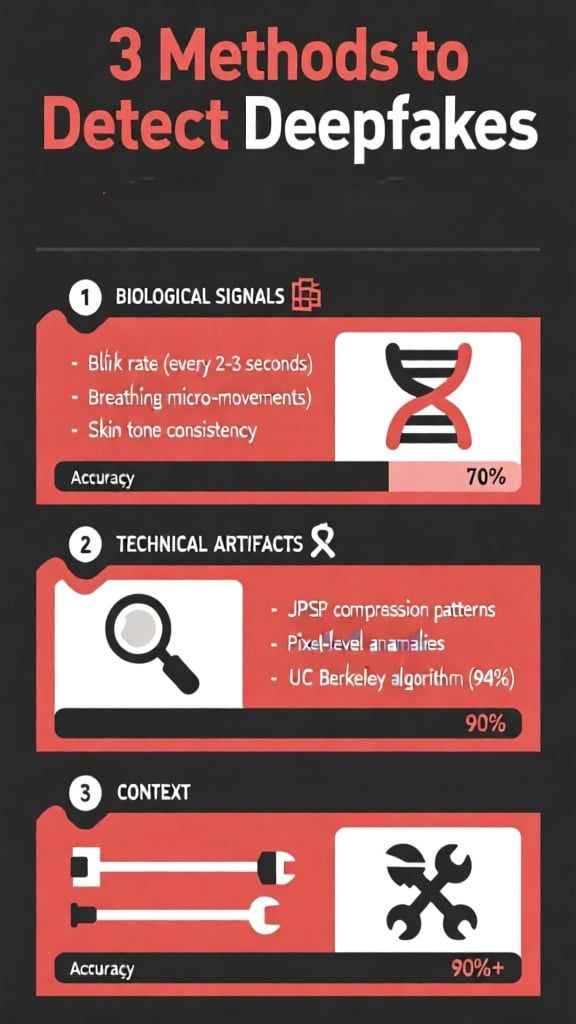
Method 1: Biological Inconsistencies
Blinking patterns (every 2-3 seconds)
Subtle movements from breathing
Naturalness of skin tone changes
Accuracy: ~70%
Method 2: Technical Artifacts
JPEG compression pattern analysis
Pixel-level anomalies
UC Berkeley algorithm: 94% accuracy
Accuracy: 90%+
Method 3: Metadata Verification
EXIF data analysis
Source cross-checking
Timeline consistency
Accuracy: Variable (easily forged)
Visual checklist showing the three detection methods with their accuracy rates and key techniques, plus "THE FUNDAMENTAL PROBLEM" box showing the endless race: Detection improves → Generation also improves → ∞ RACE
The Fundamental Problem: An Endless Arms Race
Detection algorithms advance → Generation algorithms also evolve
MIT Professor Andrew Owens: "Deepfake detection is like antivirus software. What works today may not work tomorrow."
Technology vs technology. An endless race with no finish line.
Every breakthrough in detection Becomes the training data for the next generation of fakes.
Part 4: What Should Photographers Do? - Two Paths Forward
The Same Question, Different Contexts
Zelensky deepfake: Crude, quickly exposed
TAMBURINS case: Technically perfect, legitimate replacement
One is manipulation, one is legitimate replacement.
But both ask the same question:
Does a face in a photograph still prove that person existed there?
Revisiting the 3-Layer Structure (Episode 1)
Layer 1: Physical reality Layer 2: Recording of light Layer 3: Social interpretation
Deepfake Destroys Layer 2
The recording of light is no longer connected to reality.
If Layer 2 is broken, Can Layers 1 and 3 maintain photography's meaning?
Two possible responses:
Response 1: Record More Context (Transparency)
Not just a single image, but disclose the entire production process:
What to provide:
RAW files
On-location video footage
Complete metadata
Shooting contracts
Behind-the-scenes documentation
Who's doing this:
BBC, Reuters introduced 'verifiable photography' protocols
Photojournalism organizations require process documentation
The new equation: Photograph + Evidence of process = Trust
Photographers must now provide both results + evidence of trust.
Response 2: Embrace Imperfection (Authenticity)
Deepfake pursues: Perfection, consistency, calculation Photographer captures: Contingency, mistakes, unpredictable moments
The 'decisive moment' from Episode 1 gains meaning again.
What AI can do:
Calculate probability
Optimize composition
Perfect symmetry
Eliminate flaws
What AI cannot do:
Capture pure chance
Predict the unpredictable
Embrace meaningful mistakes
Feel the unrepeatable moment

The photographer's advantage: Being there. In that unrepeatable moment. With all its imperfections.
Two-path diagram showing: PATH 1: MORE CONTEXT (Transparency) - RAW files, footage, metadata, contracts, verification protocols PATH 2: EMBRACE IMPERFECTION (Authenticity) - Contingency, mistakes, unpredictable moments, the decisive moment RESULT: Photography as Evidence + Attitude
Epilogue: In Front of the Billboard
In front of the TAMBURINS billboard. What are the tourists who once photographed Jennie now photographing?
Is that photo still a 'commemoration'?
The hundreds of photos we upload to social media:
Evidence that we truly 'existed'?
Or a combination of how we 'wanted to exist'?
The Next Question
Deepfakes attack photography's indexicality. But this is only the beginning.
As of 2024: Image-generating AI creates scenes that never existed at all.
Deepfake: Deceives about 'whose face it is'
Generative AI: Makes the question itself 'did this exist?' meaningless
The copyright battles surrounding those generated images. Now unfolding in courtrooms around the world.
Primary Sources
BBC News, "Deepfake presidents used in Russia-Ukraine war", 2022
MIT Media Lab, "Deepfake Detection Accuracy Study", 2023
WIRED, "A Zelensky Deepfake Was Quickly Defeated", 2022
UC Berkeley, "JPEG Artifact Analysis for Deepfake Detection", 2023
Field photography: TAMBURINS store, Garosu-gil, Seoul (2024)
[Episode 1: What Is Photography?] [Episode 2: The Crisis of Authenticity] → Episode 3: Deepfake - Stealing Faces (Current) [Episode 4: The Great Generation] (Next)
This series explores photography in the digital image era from philosophical, technical, and social perspectives.

Comments